News
How Does A RFID Chip Work
RFID technology is widely used in logistics, inventory management, retail, manufacturing, asset tracking, access control, and supply chain operations. Unlike traditional barcodes, RFID can identify objects through radio-frequency communication without requiring direct visual contact with each label.
But How Does A RFID chip Work, and how does an RFID system identify and track an item?
To understand how RFID works, it is important to look at the interaction between the RFID chip, antenna, RFID reader, and software system.

1. What Is RFID?
RFID stands for Radio Frequency Identification. It is a technology that uses radio waves to automatically identify and exchange data with tagged objects.
A typical RFID system consists of three main components:
- RFID tag or Inlay – Attached to the item that needs to be identified.
- RFID Reader and Antenna – Sends and receives radio-frequency signals.
- Software or Management System – Processes the RFID data collected by the reader.
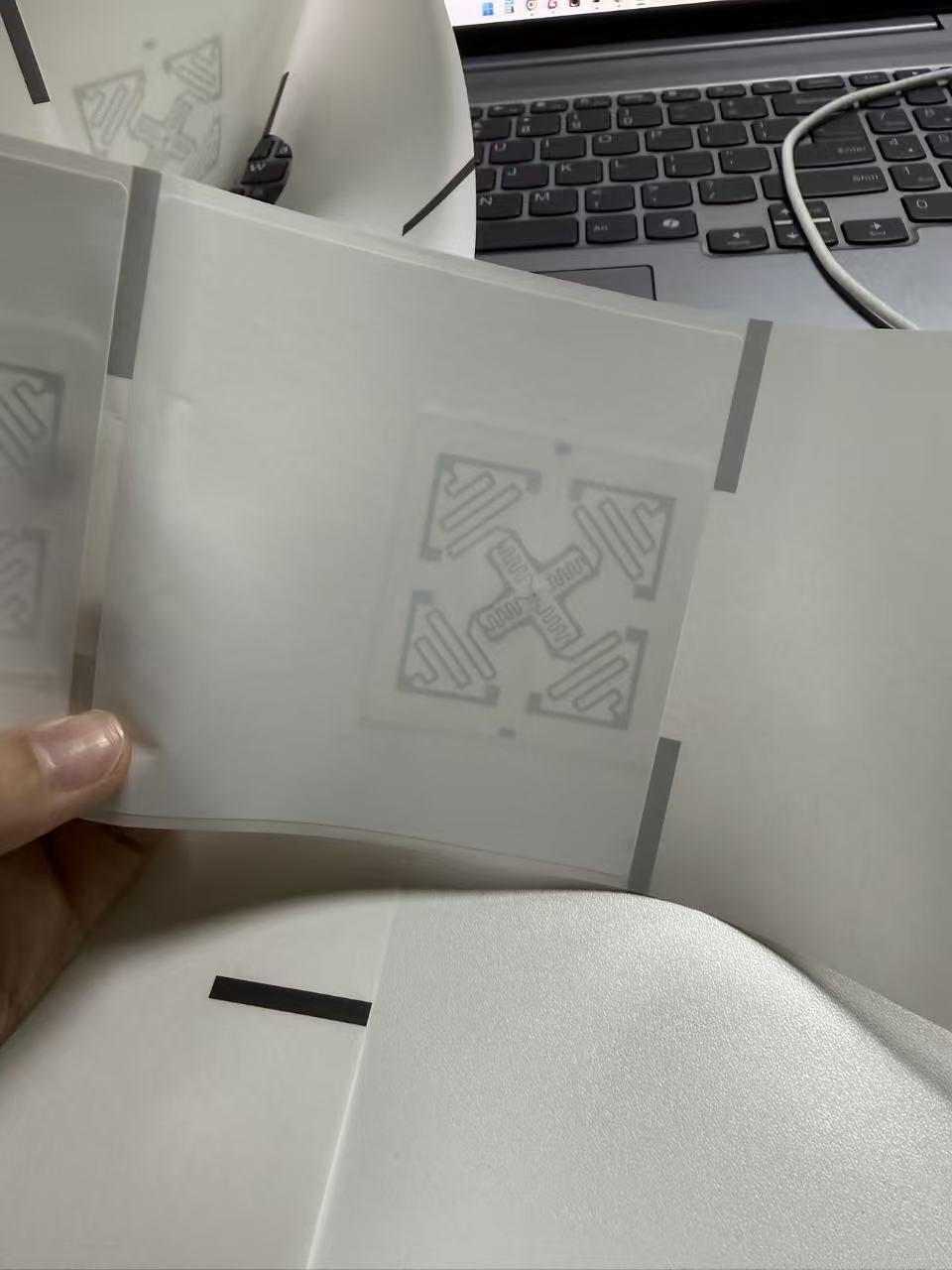
Inside an RFID tag, the two most important components are the RFID chip and the antenna.
The chip stores and processes information, while the antenna enables communication between the chip and the RFID reader.
2. How Does A RFID Chip Work?
So, How Does A RFID Chip Work?
The basic process can be divided into several steps.
Step 1: The RFID Reader Generates a Radio Signal
An RFID reader uses its antenna to transmit radio-frequency energy into the surrounding area.
When an RFID tag enters the reader's operating field, its antenna receives the RF signal.
Step 2: The RFID Tag Receives Energy
For a passive RFID tag, there is no internal battery. Instead, the tag antenna captures energy from the electromagnetic field generated by the RFID reader.
This energy is supplied to the RFID chip, allowing the chip to operate and communicate.
Active RFID tags work differently because they contain their own battery and can support longer communication ranges and additional functions.
Step 3: The RFID Chip Processes the Command
Once powered, the RFID chip interprets commands sent by the reader.
Depending on the chip and RFID protocol, the reader may request information such as:
- EPC (Electronic Product Code)
- TID (Tag Identifier)
- User Memory
- Other stored identification data
Different RFID chips provide different memory capacities and functions.
Step 4: The Tag Sends Information Back
After receiving and processing the reader's command, the tag responds with the requested information.
For passive UHF RFID systems, this commonly occurs through a process called backscatter communication. Instead of generating its own RF transmission, the tag changes how it reflects the reader's signal.
The RFID reader detects these changes and converts them into digital information.
Step 5: The Reader Sends Data to the Software
Once the reader receives the tag information, it transfers the data to a connected computer, server, ERP, WMS, inventory management platform, or other business system.
The system can then associate the RFID tag with a specific product, carton, pallet, tool, asset, or other object.
The basic RFID communication process can therefore be summarized as:
RFID Reader → Radio Signal → Tag Antenna → RFID Chip → Tag Response → RFID Reader → Software System
3. What Information Does an RFID Chip Store?
The information stored depends on the type and model of RFID chip.
For example, a UHF RFID chip may contain several memory areas.
EPC Memory stores the Electronic Product Code and is commonly used as the primary identification information for an item.
TID Memory contains information associated with the chip itself and can help identify the chip manufacturer and model.
User Memory, when available, provides additional space for application-specific information.
Some RFID chips may also support functions such as password protection, locking, read/write operations, authentication, or other security features.
Therefore, selecting an RFID chip should be based not only on reading distance but also on memory and application requirements.
4. Passive, Active, and Semi-Passive RFID Chips
RFID systems can be divided into several categories based on how the tag receives power.
Passive RFID
Passive RFID tags do not contain batteries. They receive operating energy from the RFID reader.
Their advantages include:
- Small size
- Low cost
- Long service life
- Suitable for high-volume deployment
- Low maintenance requirements
Passive RFID is widely used for inventory, retail, logistics, manufacturing, and asset identification.
Active RFID
Active RFID tags contain an internal battery that powers the tag.
They can generally support longer communication distances but are usually larger and more expensive than passive tags.
Semi-Passive RFID
Semi-passive or battery-assisted RFID tags contain a battery to power certain internal functions while still relying on communication with an RFID reader.
They can be useful for applications requiring sensors or enhanced tag performance.
5. How Do Different RFID Frequencies Work?
RFID systems operate at different frequency ranges, and frequency selection can significantly affect communication range, speed, and application suitability.
|
RFID Type |
Typical Frequency |
Common Applications |
|
LF RFID |
Around 125–134 kHz |
Animal identification, access control |
|
HF RFID |
13.56 MHz |
Cards, libraries, NFC applications |
|
UHF RFID |
Typically 860–960 MHz |
Warehousing, logistics, retail, manufacturing |
Among these technologies, UHF RFID is particularly suitable for applications where multiple items need to be identified quickly and from greater distances.
However, actual RFID performance depends on factors including antenna design, reader power, tag orientation, installation environment, materials surrounding the tag, and local frequency regulations.
6. How Can RFID Read Multiple Tags?
One major advantage of RFID compared with traditional barcode technology is its ability to identify multiple tags without scanning every item individually.
For example, RFID tags can be attached to dozens or hundreds of products stored inside cartons, shelves, containers, or warehouse areas.
When these tags enter the reader's RF field, an anti-collision protocol helps manage communication between multiple RFID tags.
This capability makes RFID particularly useful for applications such as:
- Warehouse inventory counting
- Retail stock management
- Production line tracking
- Pallet and carton identification
- Tool and equipment management
- Fixed asset tracking
- Supply chain management
7. What Determines RFID Reading Performance?
The RFID chip is important, but it is only one part of overall tag performance.
Several factors can affect RFID reading results:
RFID Chip: Different chips have different sensitivity, memory, protocols, and features.
Antenna Design: The antenna determines how efficiently the tag receives and returns RF energy.
Operating Frequency: LF, HF, and UHF systems behave differently in different environments.
Material: Metal and liquids can significantly affect RF performance, especially in UHF RFID applications.
Tag Orientation: The relative orientation between the RFID tag and reader antenna can influence reading distance.
Reader and Antenna: Reader output power, antenna gain, polarization, and installation position also affect system performance.
For this reason, choosing an RFID tag based only on the chip model may not provide the best results. The complete RFID tag design and actual installation environment should also be considered.
8. How RFID Works in Real Applications
Consider a warehouse using UHF RFID for inventory management.
Each carton or product is equipped with an RFID label containing a unique EPC number. When warehouse staff use a handheld RFID reader or when products pass through a fixed RFID reading point, the reader sends RF signals to nearby tags.
The tags respond with their identification information, and the reader collects the data.
The information can then be transferred to the warehouse management system, allowing the business to determine which items were detected and associate those IDs with inventory records.
This can reduce the need to scan every barcode individually and improve the efficiency of inventory identification.
9. RFID Chip vs. RFID Tag: What Is the Difference?
An RFID chip and an RFID tag are related, but they are not the same thing.
The RFID chip is the integrated circuit responsible for storing and processing information.
An RFID tag is the complete identification device and normally includes:
RFID Chip + Antenna + Substrate/Packaging
Depending on the application, the RFID tag may then be manufactured into different forms, including RFID inlays, labels, cards, hard tags, on-metal tags, laundry tags, or industrial RFID transponders.
10. Conclusion
Understanding How Does A RFID Chip Work starts with understanding the communication between the reader, antenna, and RFID chip.
The reader generates a radio-frequency signal, the tag receives the signal, the chip processes the reader's command, and the tag returns its stored identification information. The reader then transfers that information to the connected software system.
This relatively simple communication process makes RFID useful for inventory management, logistics, retail, manufacturing, asset tracking, and supply chain applications.
However, successful RFID deployment depends on more than the chip itself. RFID frequency, antenna design, tag construction, reader configuration, installation environment, and the materials being tagged should all be considered when selecting an RFID product.
For businesses evaluating RFID technology, testing the RFID tag in the actual application environment is one of the most effective ways to determine the appropriate chip, antenna, tag design, and reader configuration.
Categories
Latest News
Contact Us
SEIKO RFID TECHNOLOGY LTD.
Add: Rm.7127, No.350, Changle Rd., Huli District, Xiamen 361006, China.
Tel: 0595-22586002
Email: sales@seikorfid.com
Phone: +86-18559272337 (WhatsApp)