News
The new application of RFID for the big Internet manufacturers! Grab and go at the mall, no code scanning at the checkout
Shopping without going to the checkout counter, putting on your clothes and wriggling out?This in the past, do not even dare to think (I guess only thieves dare to think) things, now Amazon allows customers to open the whole thing.
Specifically, the new cashier-less technology used by Amazon combines Just Walk Out technology with RFID functionality, eliminating the need for a range of peripheral devices such as cameras to complete the checkout and payment.
The experience comes from the latest version of Amazon.com's recently released cashier-less shopping technology, which is designed to expand its applications - no longer limited to convenience stores and grocery stores, but to apparel.
Checkout is a lot faster, and the probability of skipping a check is further reduced, but there are some retailers who aren't buying it.
How about the specifics? Take a look.
Amazon's version of cashier-less technology
In fact, back in 2018, Amazon installed the “Just Walk Out” technology in more than 50 Amazon retail stores, and previously unmanned sales were conducted in Amazon Go unmanned supermarkets.
And, the old system relied on ceiling-mounted cameras and shelf sensors to determine what items customers were picking up. The system automatically swipes a credit card to pay as the customer leaves the store.
But here's the thing about the program - the system has trouble distinguishing between goods that are similar in weight and appearance. That is, until a few days ago, when things took a turn for the worse.
On Sept. 19, the retail and cloud computing giant said it had added a new element to Just Walk Out - combining its cashierless retail technology with RFID capabilities to offer more apparel and related items.
combining its cashier-less retail technology with RFID capabilities to provide a faster checkout experience for more apparel and related items.
Commenting on this, Jon Jenkins, vice president of technology at Amazon app Just Walk Out, said:
“RFID technology has been around for decades and is commonly used by stores to track and manage inventory. Given the popularity of RFID in the retail supply chain, we decided to figure out a way to make RFID work for our customers in a checkout-free environment.”
RFID checkout system, customers can simply take what they like (even if they're already wearing it) when purchasing clothes, hats, and shoes, and then when it's time to leave the shopping center, shake their hand or swipe their card and payment is complete.
As for how this is accomplished, each item has a unique RFID tag that looks just like a regular logo card.
As shoppers pass through the exit, the RFID tag on their clothing is recognized by a reader, and they can then charge their payment to their bundled Amazon One payment method and get an online invoice or receipt shortly after leaving the store.
Currently, the American football team, the Seattle Kraken, is already using this new combination of technologies to sell peripherals at their store at Lumen Field.
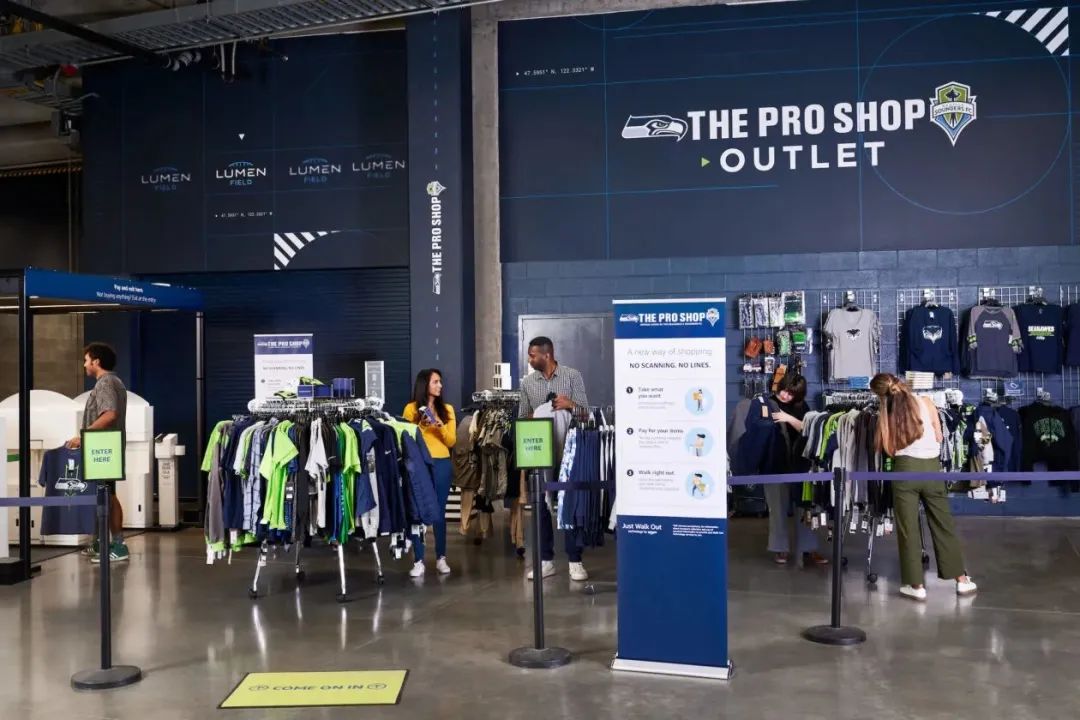
Fans can purchase Seahawks jerseys and other gear at the specialty store at Seattle's Lumen Field, which features Just Walk and RFID technology.
To enable the new Just Walk Out feature, Amazon has partnered with Avery Dennison, a provider of RFID sensors and digital identification solutions for the retail industry.
Avery Dennison is a material science and manufacturing company specializing in the design and production of a wide range of tags and functional materials, accounting for more than 50 percent of the world's ultra-high-frequency (UHF) RFID share, and in terms of scale, the company has 200 operating locations worldwide.
However, there is still uncertainty as to whether more apparel retailers will adopt the new RFID version of the technology.
A subset of retailers have expressed concern about over-reliance on the new RFID version of the technology for critical in-store information. Since RFID technology can be used to track merchandise and customers, this could have a negative impact on consumer data privacy.
But Amazon seems to be turning the problem into an advantage, as they also plan to share data from cashierless stores with relevant brands and advertisers.
By providing detailed data on shopper behavior, it could help brands and advertisers figure out how to sell more products, and in addition, the plan could help recoup some of the costs of the “Just Walk Out” system.
As for possible privacy concerns, Amazon said in a subsequent statement that it said it does not share data on individual shoppers, does not send video or images of shoppers to brands, and uses the term “aggregated and anonymized” several times.
Hundreds of billions of connections are not the end of RFID
RFID, full name Radio Frequency Identification, refers to radio frequency identification, which is what we often call electronic two-dimensional code.
This is a general term for the system that sends and receives electromagnetic and radio waves between IC tags and RFID readers (reading devices) to read and rewrite information on IC tags in a non-contact manner for automatic identification of objects and personal identity.
RFID usually do not need manual scanning, it is the way to obtain information is determined by the emission of signals, at the same time, the recognition of data is not required to have artificial intervention and help, no matter how bad the environment is can work normally. In the case of Amazon's foray into clothing stores, for example, RFID can scan multiple product labels at once.
Another important point is that reading can be achieved even at a distance or when it is out of sight. It can also read tags on products on shelves or in cartons, thus significantly reducing work time and ensuring accurate inspections.
In fact, RFID exists in many familiar places in daily life, such as transportation cards, electronic money, card keys, self-checkout machines, product inventory and so on.
As mentioned earlier, RFID can be used to read and write information by sending and receiving radio waves between IC tags and RFID readers.
So, how does information actually read and write?
Simply put, the reader sends a radio frequency signal to the tag, the tag receives and responds with its own energy to transmit the information stored in it.
This sequence is performed multiple times per second. By using an application to process the information transmitted to the RFID reader's mobile device (smartphone/handheld terminal) or computer, tasks such as inventory and stock management can be performed in a short period of time.
The technology offers several advantages over barcodes.
Advantages:
RFID has a wide reading range. Even if the distance between the IC tag and the RFID reader is a few meters to a dozen meters, UHF band RFID can also be read;.
RFID can read multiple items at once. By transmitting radio waves from the RFID reader to the IC tags, multiple IC tags within the reading range can be processed at the same time.
RFID can be left inside the product. RFID can even be read from IC tags that are located in an invisible location so that they do not need to be removed from the box and scanned like a bar code;.
RFID can seek out the target object. Users can limit and read only the IC tags they are looking for. Since the reception sensitivity of the waves varies proportionally to the distance between the RFID reader and the target object, the location of the IC tag can be recognized by pointing the RFID reader in the direction of the stronger read response and approaching it.
However, the technology has drawbacks:
RFID is susceptible to water and metal, if the IC tag is attached to a plastic bottle filled with water or a metal object, the radio waves will be absorbed and diffused, making it unreadable;.
High initial cost, when using RFID to manage items, if you prepare the same number of IC tags as the items to be managed, in addition to the RFID reader, the installation cost will be higher than if you use barcodes. This is why Amazon plans to share data from cashierless stores with brands and advertisers to reduce technology costs.
The smart labeling industry has been largely driven by RFID for the past decade or so. As one of the first commercially available IoT technologies, the RFID industry is now relatively mature and shipped more than 10 billion tags per year more than a decade ago.
Normally, when an industry has a large base, its growth rate decreases, but the RFID passive IoT connection figures show an accelerated growth trend, which is enough to show that the 100 billion connections per year is by no means the end of it.
According to the business intelligence data platform enterprise business card Quickin analysis, the current domestic RFID tag leading enterprises are Fudan Microelectronics, National Core Internet of Things, Farglory Valley, Kunrui Electronics and so on.
However, the current development of the RFID industry is also facing some urgent challenges.
The first and foremost is the chip cost.
The most widely used UHF RFID, for example, a UHF RFID inlay, the cost of the chip accounted for more than 50%, of which the chip's sensitivity, capacity, stability and other indicators determine the success or failure of the project.
In the “2023 China Wireless Identification RF Industry Research Report”, the upstream of UHF RFID is the chip manufacturers and antenna manufacturers, UHF chip manufacturers players are richer, of which NXP and English frequency Jie occupies the vast majority of the market share. With the improvement of Chinese manufacturers' R&D capability, the proportion of domestic chips is expected to increase to 30%.
In April this year, led by the rookie RFID tag chip shipments have exceeded 100 million pieces, and shipments to reach the above level, from the rookie announced the technology less than 2 years. In an interview with Wisdom, Rookie said that it has self-researched to meet the requirements of various scenarios of RFID tags, and in the scene containing metal and liquid can achieve a high recognition accuracy (>99.9%), while in the RFID read-write, a variety of forms of read-write hardware continued to invest in research and development.
Next is the packaging equipment.
In the UHF and HF tag production, there is a very core link is packaging. Labeling is a very important part of production, and millions or even tens of millions of a packaging equipment is the core of production, its function is to RFID chip and labeling package together, label binding.
Due to the RFID tag chip size is very small, the need for equipment with high precision, in addition, capacity efficiency is the most core indicators of production equipment, it is necessary to meet the high capacity to meet the requirements of high-volume production, at the same time, but also need to ensure that the performance of the product.
Finally, the cost of conductive adhesive.
Conductive adhesive refers to the RFID chip and antenna pasted together with the glue, do the label production of a consumable, inside the industry is also a key point, the market conductive adhesive brand to delo is dominated by, there are some manufacturers use other brands of conductive adhesive.
According to RFID World Network calculations, a gram of conductive adhesive can make about 2-3 million tags, to 36 billion total tags to count, the annual need to use about 1.5 million grams of conductive adhesive, each gram of conductive adhesive priced at more than 100 yuan, only conductive adhesive annual consumption amount of about 150-200 million, and as a consumable, this number will increase each year, which is an important part of the cost of the label.
Currently the global conductive adhesive industry market size is growing steadily, according to Market Insights Report, the global conductive adhesive market is valued at approximately $2,209 million in 2020, and is expected to reach $3,078 million by the end of 2026. In the global market, there are many conductive adhesive manufacturers, and the market pattern is highly concentrated, with CR3 reaching 78%. The companies with high market share are Henkel, Hitachi Chemical and Sumitomo Bakelite.
Categories
Latest News
Contact Us
SEIKO RFID TECHNOLOGY LTD.
Add: Rm.7127, No.350, Changle Rd., Huli District, Xiamen 361006, China.
Tel: 0595-22586002
Email: sales@seikorfid.com
Phone: +86-18559272337 (WhatsApp)